How New York Schools Can Cut Wasted Food in Cafeterias
In New York State, schools that successfully reduce wasted food do so by aligning four key roles around one shared goal, keeping edible food out of the trash and turning food scraps into a valuable resource. Through a proven four-role system that brings together administrators, compost champions, custodial staff, and dining services, New York schools are building cafeterias that waste less, recover more food, and run more smoothly, supported by free NYS resources and CET assistance.


Breaking Down the Four Roles Behind a Successful Cafeteria
The Role of Administrators
Making the system possible
Without administrative support, kitchen and custodial teams are left trying to run a system that does not have the infrastructure to succeed.
Download the resource

The Role of Compost Champions
Teaching students how to sort correctly
Compost Champions are the people who make cafeteria sorting stick.
This peer-to-peer and adult-to-student guidance is one of the most powerful tools for reducing contamination and keeping compost usable.
Download the resource

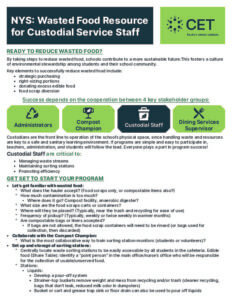
The Role of Custodial Staff
Protecting the system on the ground
Custodial teams are the frontline of food waste diversion. They are the ones who see what actually ends up in the trash, recycling, and compost every day.
When custodial staff are part of the system, schools get real-time data about what is working and what is not.
Download the resource
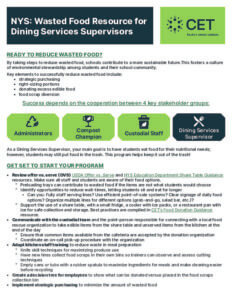
The Role of Dining Services Supervisors
Designing food systems that students actually eat
Dining Services Supervisors sit at the center of wasted food prevention. Their job is not just serving meals, it is designing how food moves through the cafeteria.
This ensures that edible food stays edible and food scraps are separated correctly instead of being contaminated.
Download the resource