CET Turns 50!
By Nancy Nylen, Chair of the Board of Directors of CET
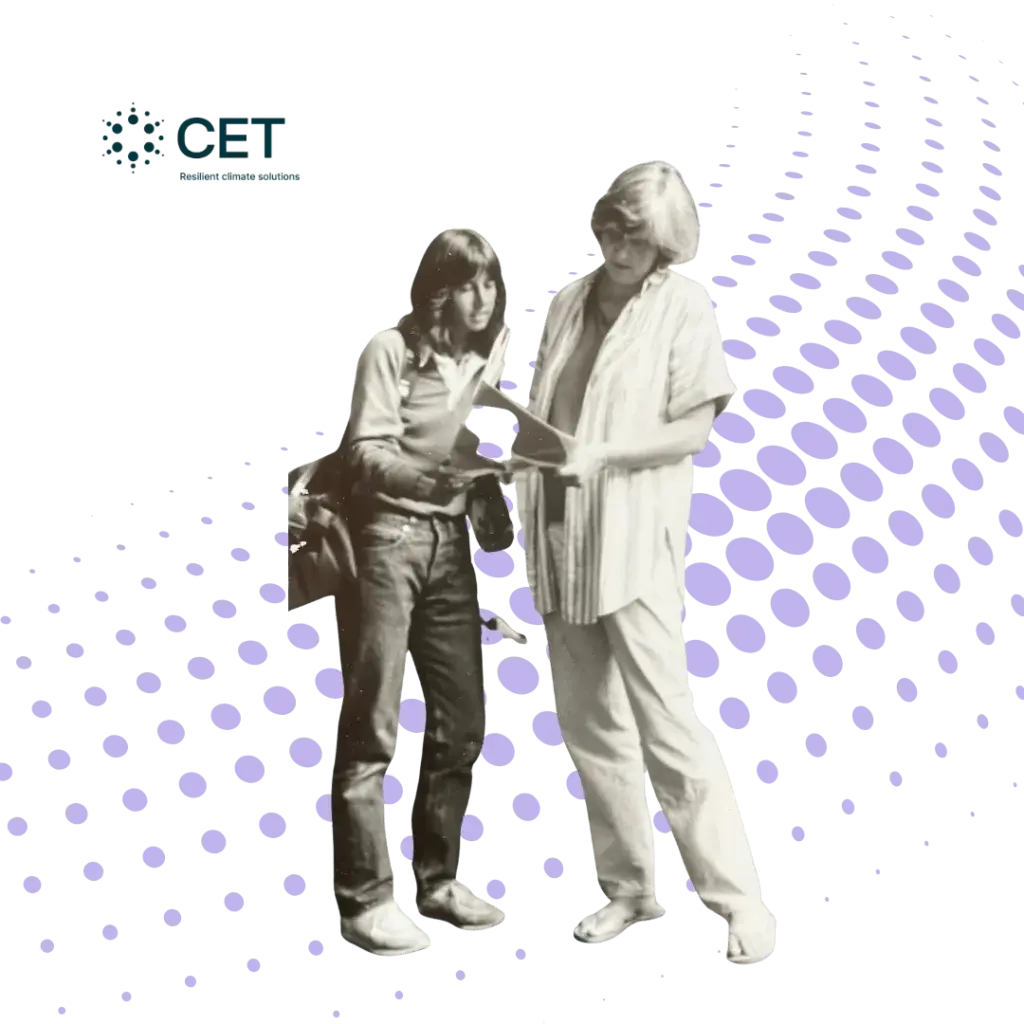
Little did i know…
When I walked into CET’s office for a job interview in September 1982, an excited, slightly nervous young woman, that I would be helping chronicle the history of this extraordinary organization that has been such an important part of my life for 44 years.
But here I am, with some trepidation, looking forward to writing a bit about each of CET’s five decades in the year ahead. And though I know I can’t begin to capture all that is CET, I hope that my recollections will remind you of your own stories, and what this remarkable organization has meant to you and to so many others for half a century.
So here goes.
CET’s first decade: 1976-86
For those readers who weren’t yet alive or were too young to have memories of the 1970s, let me set the stage.
The first Earth Day had taken place in 1970, landmark environmental legislation, including the Clean Air, Clean Water and Endangered Species Acts were all passed, and the U.S. Environmental Protection Agency had just been formed. We hadn’t heard about global warming yet but we worried about the pollution from burning fossil fuels. We also worried that these non-renewable resources would soon run out.
But perhaps the single most important event leading to the founding of CET was the oil embargo of 1973-74 that ushered in the first oil crisis. At that time, the U.S. imported nearly 80% of our oil. When OPEC cut off supplies, prices skyrocketed, fuel was rationed, and we learned first-hand the consequences of our dependence on other countries for our oil. Here in the Northeast, not only did we rely on petroleum to fuel our cars but also to heat our homes, schools, and businesses.
The combination in the mid-1970s of the oil crisis and growing environmental awareness paved the way for CET’s founding. Across the country, state and federal energy offices were being established and environmental organizations started cropping up to decrease our dependence on imported, expensive, polluting, non-renewable fossil fuels.
Enter CET
In October 1976 in Pittsfield, J.D. “Ned” Nisson, a part-time faculty member at Berkshire Community College, with a newly earned environmental engineering degree, an interest in “appropriate technology”, and a vision, filed papers with the IRS to form a non-profit organization called the Center for Ecological Technology, “To research, develop and demonstrate technologies which will have the least disruptive impact upon the natural ecology of the Earth.”
First Home Energy Audits and “Green” Jobs
By the spring of 1977, Ned had secured a $65,000 Comprehensive Employment and Training Act grant to hire and train staff to conduct the region’s first home energy audits for 2000 homeowners and renters.
CET was off and running – a pioneer in the world of energy efficiency and green jobs.
By the time I discovered CET five years later, CET had established itself as a community organization that had not only pioneered “personalized” home energy audits, but had piloted a program to install solar thermal collectors for home heating, and erected a passive solar greenhouse that is still in place today at Berkshire Botanical Gardens in Stockbridge, MA.
I had just moved to the Berkshires in western Massachusetts. For the previous eight years I’d worked at agencies in Alaska, Washington and most recently New Mexico, promoting energy conservation and solar energy technologies and was hopeful, but not entirely optimistic, about continuing this work in rural western Massachusetts.
At a fateful meeting with Nan Jenks-Jay at Williams College’s Center for Environmental Studies, I learned about CET. “They’re a small non-profit in Pittsfield and I know someone there I could call for you,” she offered. As luck would have it, Alan Silverstein picked up and said one of CET’s staff members was about to go on maternity leave and they were looking for someone to help start up a new energy conservation program for small businesses.
Early Days of CET
This early rack card highlights CET’s first efforts to help residents reduce energy costs, laying the foundation for decades of impact.

Finding CET
The September 7th entry in the 1982 Audubon Engagement Calendar (remember those?) that I unearthed while cleaning my basement a few years ago read “met with Alan, Laura, Stephanie and Nancy – long and fun meeting – job possibility!” which is exactly how I remember it.
The office was a big open space with large windows overlooking North Street in Pittsfield, filled with a collection of second-hand metal desks and filing cabinets, a large “meeting” table, assorted chairs, an electric typewriter, telephones at each desk, and a single desktop computer that staff fondly called “Rita”.
I met with three of CET’s four staff members, Laura Dubester, Alan Silverstein, and Stephanie Boszko, along with Nancy Shea, a board member. I learned that Laura had recently taken over as the director of CET when her friend Ned left to start Energy Design Update, a news journal for building professionals. They regaled me with stories of their successes and challenges as a non-profit organization with a small but dedicated, hard-working staff.
I left feeling almost giddy about how great these people were and all they were accomplishing. And then sure enough, further down the page of that same calendar was the entry for Friday, September 10th in blue ink, all caps, JOB AT CET OFFERED!
Inside CET in the early days
My first assignment was to read The Berkshire Energy Manual produced by CET in 1980. I recently pulled it off my shelf, and it’s uncanny how relevant it still is today. Written when we were still reeling from the energy crisis of the 1970s, the manual was “a practical guide” to conserving energy and adopting solar, wind and hydro with a goal of “reducing our dependence on imported” and other polluting, and non-renewable fossil fuels.
The first program I worked on was the Small Business Conservation Assistance Program, described in our 3-fold promotional brochure as “…a free service for small business owners in Pittsfield and the Springfield area to help them find the best ways to save energy in their business.” Sound familiar?
Absent the internet and social media, we relied on direct mail, press releases, letters to the editor, attending Chamber of Commerce and Rotary Club meetings, and radio talk shows to promote and educate the public about this still new concept called an energy audit. And people responded. Perhaps most effective, though, was word of mouth, as most of CET’s work that first decade was in Pittsfield and surrounding Berkshire communities. I remember walking down North Street with Alan later that fall, and saying, “…you should run for Mayor, you know everyone.”
Without cell phones, GPS, or even Map Quest, we relied on calling businesses (on what we now call landlines) to get detailed directions to their locations. I soon learned that in New England almost all directions include a landmark that is no longer there, like “turn right just past where the old fire station used to be.” I stopped at many a gas station or pay phone when I inevitably got lost.
I still remember those first visits. I would arrive, armed with a clipboard, tape measure, calculator, and an energy audit form we worked hard to tailor to the different types of businesses. We checked insulation levels, condition of heating equipment, and in some instances set up a Blower Door to measure air infiltration. One of my greatest challenges was figuring out how to fit the bulky fan and door frame into the back of my Volkswagen Jetta.
Doing the work
I loved meeting owners and managers, learning about what they did, and talking with them about the role energy played in running their business, be it a creamery, a market, an office building, a restaurant or a furniture store. I’ll never forget walking through the “preparation room” of a funeral parlor during one energy audit, or how absolutely enthralled I was entering the basement of the Old Corner House on Main Street in Stockbridge where Norman Rockwell’s unexhibited artwork was stored.
In addition to visiting businesses, I also got to do home energy audits. Again, I loved meeting people and talking with them about their homes and ways to save them money and make them more comfortable.
There was no Mass Save yet. We gave people information and recommendations to weatherize and insulate their homes, but we couldn’t offer them funding. We didn’t install energy efficient lighting, because there was none. We told people to turn off their lights when not in the room. We didn’t install programmable thermostats, because they weren’t yet available for homes. We told people to turn down their heat at night and when at work.
Discover the full range of home improvements supported through the Energy Saver Home Loan Program.
Moments that stayed with me
Not long ago, at an information session about home energy conservation and solar energy, a couple approached me and said they remembered me coming to their home to do an energy audit. It took me a minute—I hadn’t done home energy audits since 1985—but then I remembered them too. And their home.
It reminded me that some things are constant. We continue to provide energy audits. We still have a “personalized” approach, and the disruption of oil supplies in the Middle East is again affecting the world economy.
It reminded me that many things have changed. Our technology, our focus on combatting global climate changes, and the increased support of state and utility policy, programs and incentives…and until recently, federal government support as well.
It reminded me most of all that the work we do makes a difference. And that the work CET is doing today is more important and urgent than ever—and our ability to make a difference has never been so great.
I could go on. But I’ll stop here, and invite you to share your stories, reflections or questions about those early years of CET, as I look forward to joining you again in a few months with highlights from our second decade: 1986-1996.
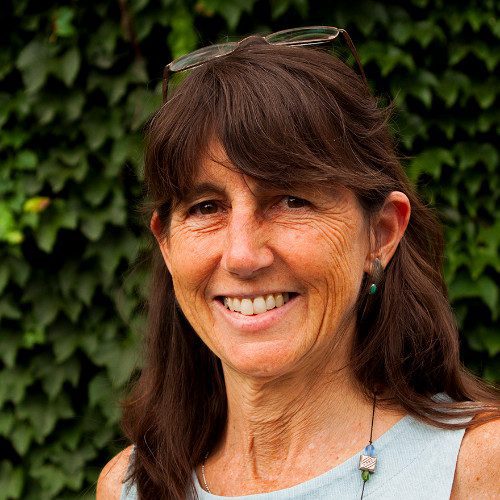
Nancy Nylen
Nancy Nylen is an independent consultant and environmental educator, specializing in the fields of energy efficiency, renewable energy, and resource conservation. She currently serves as Chair of the Board of Directors of CET, where she previously worked for more than three decades on innovative programs focusing on local solutions to energy issues that benefit the economy, natural environment, and quality of life for community members.