
Blog

1986–1996: CET Comes of Age

Part 2 of the CET Turns 50 series

By Nancy Nylen

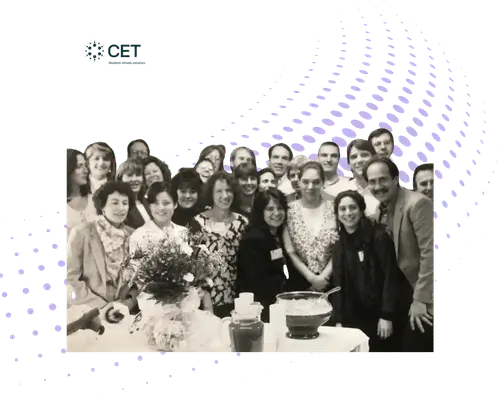
CET staff at 1996

Nancy Nylen

Nancy Nylen is an independent consultant and environmental educator, specializing in the fields of energy efficiency, renewable energy, and resource conservation. She currently serves as Chair of the Board of Directors of CET, where she previously worked for more than three decades on innovative programs focusing on local solutions to energy issues that benefit the economy, natural environment, and quality of life for community members.


A Defining Decade

If CET’s first ten years were a time of birth and early development, I think of the second decade as CET’s Coming-of-Age, when we grew, expanded our horizons, and became a more established organization with a more fully formed identity.  

Guided by the passionate leadership of Laura Dubester and Alan Silverstein, we continued to innovate and to provide practical solutions to pressing environmental and economic challenges.

As CET ventured into new geographies and program areas, we developed a track record for quality work and responsiveness to the needs of the local community.

Looking back on all we did and accomplished, it was this decade that we fully asserted our identity as an organization that’s uniquely able—and determined—to unlock environmental solutions using creative financing, programming, and people-centered approaches. 

It’s hard to do justice to a decade in a single post, but I’ll share some highlights that I think capture the scope and spirit of those years that established the work and approaches that still define CET today.

CET pioneered creative financing for energy efficiency and solar energy 

To help homeowners and landlords overcome the upfront cost of energy efficiency upgrades, like insulation, windows, and doors, CET helped pioneer the HEAT (Home Energy Assistance Team) loan program, working with local lenders to offer 0% interest energy loans for income eligible residents.

The program was so popular I remember needing to stamp “Funds No Longer Available” on our brochures when state funding used to write down the interest rate ran out. 

To help homeowners afford solar hot water systems, CET raised funds locally to administer the Solar Bank program. 

We worked with local lenders to provide 0% financing AND write down the principal, enabling installation of nearly 1,000 solar hot water systems in the Berkshires over two years.

From the Archives

Early CET Brochure

An early CET brochure showcased the organization’s expanding services.

CET expanded energy services for small businesses, non-profits, manufacturers, and municipalities

When state and federal funding for energy efficiency became available for public buildings, CET helped pioneer the Energy Circuit Rider Program, assisting smaller communities to write grants to retrofit their town buildings.

Similarly, CET participated in the innovative Non-Profit Energy Efficiency Program (NEEP), to provide nonprofit organizations in western Massachusetts with needed assistance identifying opportunities and funding to make their buildings more energy efficient and less costly to operate.

CET applied our experience with the energy crisis to the garbage crisis 

CET focused almost exclusively on energy-related programs until the late 1980s when another crisis emerged that affected our region: the garbage crisis

People were steadily buying more disposable products and seemingly overnight, landfills were at capacity and there was nowhere for cities and even some small towns to dispose of their garbage. 

Recycling programs were in their infancy and city planners were caught unprepared. 

Employing the same practical, people-centered problem-solving we used for energy, CET responded to this new crisis addressing policy, education, and environmental action by:

Working with towns to pass mandatory recycling bylaws
Working with businesses to identify ways to reduce and recycle waste
Conducting teacher training programs and teaching children about papermaking and recycling
Educating and providing technical assistance to residents and towns to reduce, reuse, recycle, and compost their waste.
Distributing 2,000 composting containers
Forming a paper recycling co-op for small, Pittsfield area businesses. 

CET expanded our staff and operations to meet growing demand

As our scope and programs grew, demand for one-on-one assistance grew in the Berkshires and then the Pioneer Valley. In response, we expanded our staff and began meeting with residents in borrowed offices in Northampton, until we opened our own in 1987.

As our staff and programs grew, we relocated our offices in Pittsfield several times, causing disruption and a yearning to have a place of our own.

In 1992, we purchased a building on Elm Street in Pittsfield that became CET’s home for nearly 30 years.

What Can You Upgrade with the Energy Saver Home Loan?

Discover the full range of home improvements supported through the Energy Saver Home Loan Program.

The late 1980s and early 1990s

As I look back on these Coming-of-Age years of CET in the late 1980s and early 1990s, I see how seminal this decade was for establishing CET’s identity as an innovative, solution-based organization.

These years laid the foundation for the creative, impactful, and responsive energy efficiency, clean energy, and waste management programs we offer today.

On a personal level, I had many “favorite jobs” during my time at CET, and many of them were during this decade. I loved helping people install solar hot water via the Solar Bank program.

I enjoyed working with town officials and volunteers to pass mandatory recycling bylaws so they would be eligible to bring their recyclables to the new Springfield Materials Recycling Facility. I loved going into the schools to work with teachers and students.

Perhaps my favorite, though, was getting to be the Energy Circuit Rider for Berkshire County. I spent my days, and many evenings, traveling to small towns to help them write grants to install energy efficiency improvements in their municipal buildings.

I loved the job for many reasons. I was still relatively new to the area, and it gave me a chance to spend time in the little towns I’d barely heard of. I loved meeting the people and learning what was important to them. I enjoyed visiting town halls, schools, libraries, and highway departments, exploring and learning the history of their buildings, gathering data, researching costs, and estimating savings.

It was rewarding to know that town employees, teachers, and students would be more comfortable, and towns would be saving money now that their walls and attics were insulated and energy efficient heating systems were installed.

Most of those improvements were invisible, though, hidden in walls, attics and basements. I guess that’s why I still love driving by a town garage and smiling when I see an insulated garage door and thinking—We did that!

And I hope that whether you’re a current or past staff member, someone who benefited from CET’s services, or supporter and friend of CET you feel as proud as I do, of this extraordinary organization that has been making a difference for 50 years.

Some highlights from that time

1986

President Ronald Reagan and his administration made headlines for removing the solar panels Jimmy Carter had previously installed on the White House. 

1987

The infamous “garbage barge” became the icon for the garbage crisis – as it floated around the Atlantic Ocean in search of a home to dispose of its load.  

1989

The advent of the World Wide Web.  

1989

The devastating Exxon Valdez oil spill in Prince William Sound, Alaska.  

1990

President George H. Bush championed and signed amendments to the Clean Air Act introducing an innovative market-based cap-and-trade system. 

1990

The Springfield Materials Recycling Facility (MRF) opened, a state-owned facility that processes recyclable paper, plastic, and metal for over 65 municipalities in western MA. 

1992

Earth Summit in Rio, where President Bush signed the UN Framework Convention on Climate Change, a foundation for future global climate negotiations. 

1992-96

Widespread adoption of email, desktop and laptop computers and growing awareness and concern for global warming and climate change. 

Donate to CET!

Your donation is more than just financial support. It’s a catalyst for innovation, action, and scalable solutions that accelerate the fight against climate change

join our work, Talk to us!

We’re excited to help you decarbonize with energy and waste solutions.

get resilient content!

Get the month scoop on climate & sustainability! - unsubscribe anytime!

SUPPORT

Sustainable Partners
Toolkits
Sectors
Programs

GET INVOLVED

Donate
Careers
About Us
Board

CONNECT

Contact Us
Press + Media
Hotline
Accesibility Statement
Scroll to Top